India Budget 2026 summary
India Budget 2026 Summary: Key Highlights, Tax Changes & Economic Impact Explained
The India Budget 2026 summary reveals a growth-oriented yet fiscally disciplined roadmap aimed at accelerating India’s journey toward Viksit Bharat. Presented on February 1, 2026, the Union Budget 2026-27 balances capital expenditure expansion, domestic manufacturing push, tax simplification, and inclusive development—while maintaining a steady fiscal consolidation path.
In this detailed India Budget 2026 summary, we break down the major announcements, sectoral reforms, tax updates, and long-term economic implications.
Overview: Growth with Fiscal Prudence
Finance Minister Nirmala Sitharaman presented her ninth consecutive Union Budget, structured around three national priorities:
- Sustained economic growth through productivity and resilience
- Empowering citizens as partners in prosperity
- Inclusive development across regions and sectors
At its core, the India Budget 2026 summary reflects a strategy that combines infrastructure expansion, industrial competitiveness, and social inclusion with disciplined deficit management.
Manufacturing & Strategic Technology Push
A major takeaway from the India Budget 2026 summary is the government’s aggressive focus on advanced manufacturing and strategic capabilities.
Biopharma SHAKTI – ₹10,000 Crore Initiative
The government has launched Biopharma SHAKTI, a five-year ₹10,000 crore program aimed at positioning India as a global hub for biologics and biosimilars manufacturing.
Key features include:
- Three new National Institutes of Pharmaceutical Education & Research (NIPERs)
- Upgradation of seven existing institutes
- Creation of 1,000+ accredited clinical trial sites
- Strengthened domestic production of biologics
This move reduces import dependency and strengthens healthcare innovation.
ISM 2.0 & Electronics Expansion
The India Semiconductor Mission 2.0 (ISM 2.0) aims to:
- Promote domestic semiconductor equipment production
- Develop full-stack Indian intellectual property
- Strengthen supply chains
- Establish industry-led research and training centers
The Electronics Components Manufacturing Scheme outlay has been increased to ₹40,000 crore, reinforcing India’s ambition to become a global electronics supply chain leader.
Rare Earth Corridors & Capital Goods Strengthening
To reduce reliance on imported critical minerals, Rare Earth Corridors will be developed in:
- Odisha
- Kerala
- Andhra Pradesh
- Tamil Nadu
These corridors will cover mining, processing, research, and magnet manufacturing.
Additionally, the Budget includes:
- Hi-Tech Tool Rooms by CPSEs
- Construction & Infrastructure Equipment (CIE) Enhancement Scheme
- ₹10,000 crore Container Manufacturing Scheme
This industrial push forms a key pillar of the broader India Budget 2026 summary.
MSMEs: Building “Champion SMEs”
Recognizing MSMEs as India’s growth engine, the Budget introduces a three-pronged support system:
Equity Support
- ₹10,000 crore SME Growth Fund
- ₹2,000 crore top-up to Self-Reliant India Fund
Liquidity Support
- Expanded use of TReDS platform
Professional Compliance Support
- ‘Corporate Mitras’ to assist MSMEs in Tier-II and Tier-III cities
These reforms aim to scale MSMEs into globally competitive enterprises.
Infrastructure & Capital Expenditure Surge
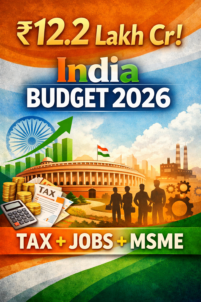
Public capital expenditure has been increased to ₹12.2 lakh crore for FY27, reinforcing infrastructure as a growth multiplier.
Key Infrastructure Announcements
Major initiatives include:
- New freight corridors
- Development of 20 national waterways over five years
- Coastal cargo promotion
- Incentives for seaplane manufacturing and operations
- Seven high-speed rail inter-city corridors
Tier-II and Tier-III cities will be developed as City Economic Regions (CERs), each receiving ₹5,000 crore over five years through reform-linked allocations.
Medical Tourism & AYUSH Expansion
Healthcare receives a major boost through:
- Five Regional Medical Value Tourism Hubs
- Three new All India Institutes of Ayurveda
- Upgradation of AYUSH pharmacies and drug testing labs
- Strengthening the WHO Global Traditional Medicine Centre in Jamnagar
This initiative enhances India’s global medical tourism footprint.
Fiscal Deficit & Debt Outlook
Fiscal consolidation remains central to the India Budget 2026 summary:
- Fiscal deficit estimated at 4.4% (RE 2025-26)
- Reduced to 4.3% (BE 2026-27)
- Debt-to-GDP projected at 55.6% in 2026-27
The long-term target remains 50 ±1% by 2030-31, signaling sustained macroeconomic discipline.
Financial Sector & Capital Markets Reforms
Key reforms include:
- High-Level Committee on Banking for Viksit Bharat
- Restructuring of PFC and REC
- Review of FEMA rules
- Corporate bond market-making framework
- Bond index derivatives and total return swaps
- ₹100 crore incentive for large municipal bond issuances
These steps aim to deepen capital markets and improve urban infrastructure financing.
Jobs, Skills & Human Capital Development
The Budget sets ambitious employment-linked targets:
- 1 lakh Allied Health Professionals over five years
- 5 lakh caregivers annually
- AVGC Creator Labs in 15,000 schools and 500 colleges
- A new National Institute of Design in eastern India
- Five University Townships
- Girls’ hostel in every district for STEM support
- Expanded Khelo India Mission
Human capital development remains a core strength of this year’s fiscal strategy.
Tourism, Culture & Heritage Development
15 major archaeological sites—including:
- Lothal
- Dholavira
- Sarnath
- Hastinapur
—will be developed as experiential tourism destinations, supported by a National Destination Digital Knowledge Grid.
Direct Tax Reforms & Compliance Simplification
The Income Tax Act, 2025 becomes effective April 1, 2026.
Major reforms include:
- Full tax exemption on Motor Accident Tribunal interest (no TDS)
- TCS reduced to 2% on overseas tour packages and education/medical remittances under LRS
- Extended timelines for revised and belated returns
- Easier lower/nil TDS certificate process
- FAST-DS 2026 for small taxpayers
- Expanded relief for cooperative societies
These reforms simplify compliance and reduce litigation.
Customs & Trade Reforms
Key trade reforms include:
- Single digital clearance window by FY26
- AI-based risk assessment
- Removal of ₹10 lakh courier export cap
- Customs duty on personal imports reduced to 10%
- Full exemption on 17 cancer drugs and treatments for seven rare diseases
- Faster cargo clearance and warehouse modernization
This strengthens ease of doing business and export competitiveness.
Other Tax Proposals
- Share buybacks taxed as capital gains
- Additional levy on promoters
- TCS rationalised to 2% on liquor, scrap, minerals, and tendu leaves
- STT on futures increased to 0.05%
- STT on options increased to 0.15%
- MAT reduced to 14% and made final tax
Final Analysis: What India Budget 2026 Means for Growth
This comprehensive India Budget 2026 summary highlights a policy direction that blends growth acceleration with macroeconomic stability. With higher capital expenditure, stronger manufacturing ecosystems, MSME empowerment, human capital investment, and simplified tax frameworks, the Budget aims to build durable economic momentum.
Overall, the India Budget 2026 summary signals a reform-driven, investment-focused, and inclusive approach designed to sustain long-term growth while advancing India’s transformation into a developed economy.
- What are the key highlights of the India Budget 2026 summary?
The India Budget 2026 summary highlights increased capital expenditure of ₹12.2 lakh crore, fiscal deficit reduction to 4.3%, semiconductor and biopharma push, MSME growth funds, tax simplification, and infrastructure expansion including freight corridors and waterways.
- How does the India Budget 2026 summary impact taxpayers?
The Budget introduces the new Income Tax Act effective April 1, 2026, reduces TCS on overseas remittances to 2%, simplifies compliance, extends ITR filing timelines, and provides tax relief on certain tribunal interest payments.
- What benefits are announced for MSMEs in Budget 2026-27?
MSMEs receive equity support through a ₹10,000 crore SME Growth Fund, expanded TReDS liquidity access, and compliance assistance via Corporate Mitras to help small businesses scale efficiently.
- How will Budget 2026 support manufacturing and technology?
The Budget launches Biopharma SHAKTI (₹10,000 crore), expands semiconductor production under ISM 2.0, increases electronics manufacturing outlay to ₹40,000 crore, and develops rare earth corridors to reduce import dependency.
- What is the fiscal deficit target in Budget 2026?
As per the India Budget 2026 summary, the fiscal deficit is estimated at 4.4% in RE 2025-26 and reduced to 4.3% in BE 2026-27, with a long-term goal of lowering debt-to-GDP to 50% ±1% by 2030-31.
- What infrastructure projects are announced in Budget 2026?
Major announcements include seven high-speed rail corridors, 20 national waterways over five years, new freight corridors, City Economic Regions for Tier-II & III cities, and incentives for seaplane operations and coastal cargo.
- How does the India Budget 2026 summary promote jobs and skills?
The India Budget 2026 summary outlines 1 lakh allied health professionals over five years, 1.5 lakh caregivers annually, AVGC labs in schools and colleges, new university townships, and expanded Khelo India initiatives to boost employment and skill development.
For more updates check official website-https://www.indiabudget.gov.in/
DISCLAIMER
Airfinac.com, its author/writer and associates do not provide tax, legal or accounting advice. This material has been prepared for informational purposes only, and is not intended to provide, and should not be relied on for, tax, legal or accounting advice. You should consult your own tax, legal and accounting advisors before engaging in any transaction.