E Invoicing under GST 2026: Applicability, Rules, Time Limit & Complete Compliance Guide
E invoicing under GST 2026 has become one of the most important compliance requirements for businesses in India. Many still assume it means generating invoices on a government portal—but in reality, it involves reporting invoice data to the Invoice Registration Portal (IRP) and obtaining a unique Invoice Reference Number (IRN).
With stricter timelines and growing scrutiny on Input Tax Credit (ITC), understanding e invoicing under GST 2026 is essential for avoiding penalties and ensuring smooth business operations.
📌 What is E Invoicing under GST 2026?
Under e invoicing under GST 2026, businesses are required to upload invoice details to the IRP for validation. Once approved, the system generates:
- A unique IRN (Invoice Reference Number)
- A QR code for authentication
👉 External Link Suggestion: Add anchor text like “Check official GST e-invoicing guidelines” linking to the Goods and Services Tax Network to improve SEO trust and authority.
🏢 Who is Required to Generate E-Invoice in 2026?
📊 Turnover Criteria (Latest Rule)
As per e invoicing under GST 2026, e-invoicing is mandatory for:
- Businesses with aggregate turnover exceeding ₹5 crore
- In any financial year from FY 2017-18 onwards
👉 This threshold continues unchanged from 1st April 2026.
⚠️ Key Points You Must Know
- Turnover is calculated on a PAN basis (all GSTINs combined)
- Includes:
- Taxable supplies
- Exempt supplies
- Exports
- Inter-state supplies
📘 Example 1: Applicability Based on Past Turnover
| Year | Turnover |
| FY 2021-22 | ₹6 Cr |
| FY 2025-26 | ₹3 Cr |
➡️ Since turnover exceeded ₹5 Cr earlier, e invoicing under GST 2026 remains applicable in FY 2026-27
📘 Example 2: PAN-Based Turnover
- Delhi GSTIN: ₹3 Cr
- Haryana GSTIN: ₹3 Cr
➡️ Total = ₹6 Cr → E-invoicing applies to both GSTINs
🔄 Transactions Covered under E-Invoicing
✅ Applicable Transactions
- B2B (Business-to-Business) supplies
- Export transactions
- Supplies to SEZ units/developers
- Deemed exports
- Government supplies (B2G)
❌ Not Applicable
- B2C (Business-to-Consumer) supplies
- NIL-rated / non-GST supplies
📘 Example 3: Transaction-Level Rule
- Sale to registered dealer → ✅ E-invoice required
- Sale to end consumer → ❌ Not required
⏳ Time Limit for Generating E-Invoice (Very Important)
For businesses with turnover ₹10 crore or more:
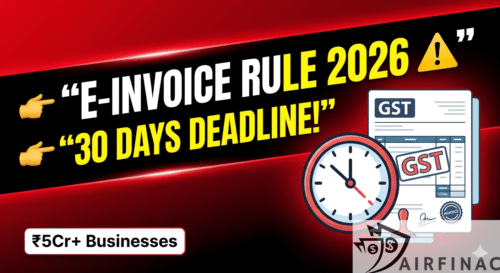
👉 Under e invoicing under GST 2026, invoices must be uploaded to IRP within 30 days from the invoice date
⚠️ Consequences of Missing the Deadline
- IRN will not be generated after 30 days
- Invoice becomes invalid under GST law
📘 Example 4: Time Limit Impact
- Invoice Date: 1 April 2026
- Upload Attempt: 5 May 2026
➡️ Delay beyond 30 days
❌ IRN cannot be generated
❌ Invoice invalid
❌ Buyer may lose ITC
🚫 Who is Exempt from E-Invoicing?
Even if turnover exceeds ₹5 crore, the following are exempt:
- Banking companies / NBFCs
- Insurance companies
- Goods Transport Agencies (GTA)
- Passenger transport services
- Cinema exhibition businesses
- Government departments / local authorities
📘 Example 5: Exemption Case
A bank with ₹500 Cr turnover → ❌ Not required to generate e-invoice
⚠️ Consequences of Non-Compliance
Non-compliance with e invoicing under GST 2026 can lead to serious financial and legal risks.
🚨 Practical Impact
- Invoice treated as invalid
- Buyer may lose Input Tax Credit (ITC)
- Penalties under GST law
- Risk of litigation
📘 Example 6: Real Risk Scenario
- Supplier issues invoice without IRN
- Buyer claims ITC
➡️ Department may deny ITC stating:
“Invoice is invalid as e-invoice was not generated”
📉 Evolution of E-Invoicing Threshold
| Effective Date | Threshold |
| Oct 2020 | ₹500 Cr |
| Jan 2021 | ₹100 Cr |
| Apr 2022 | ₹20 Cr |
| Oct 2022 | ₹10 Cr |
| Aug 2023 onwards | ₹5 Cr |
👉 No further reduction has been announced as of April 2026.
✅ Practical Compliance Checklist
To stay compliant with e invoicing under GST 2026, businesses should:
- ✔ Review turnover from FY 2017-18 onwards
- ✔ Verify PAN-based turnover
- ✔ Integrate systems with IRP
- ✔ Monitor 30-day deadline (₹10 Cr+)
- ✔ Train accounting teams
- ✔ Validate IRN before issuing invoice
👉 Internal Link Idea: Link to “GST Compliance Checklist for Businesses in 2026” to improve internal SEO structure.
🔑 Key Takeaways
- ₹5 crore threshold continues in 2026
- Past turnover determines applicability
- 30-day rule is critical for large taxpayers
- Non-compliance leads to invalid invoices
- ITC denial is the biggest financial risk
🔍 Final Thoughts
E invoicing under GST 2026 has evolved into a strict compliance framework rather than just a procedural requirement. With tighter timelines and direct ITC implications, businesses must ensure timely and accurate invoice reporting.
Staying compliant with e invoicing under GST 2026 will not only help avoid penalties but also protect your business from financial losses and legal complications.
For GST Official site Click Here
Frequently Asked Questions (FAQs)
- What is e invoicing under GST 2026?
E invoicing under GST 2026 refers to the system where businesses report invoice details to the IRP and generate an IRN, ensuring authenticity and real-time validation of invoices.
- Who is required to generate e-invoice in 2026?
Businesses with an aggregate turnover exceeding ₹5 crore in any financial year since FY 2017-18 are required to comply with e-invoicing rules.
- What is the time limit for generating e-invoice under GST?
Under e invoicing under GST 2026, businesses with turnover of ₹10 crore or more must upload invoices to the IRP within 30 days from the invoice date.
- Is e-invoicing applicable for B2C transactions?
No, e-invoicing is not applicable to B2C transactions. It is mainly required for B2B, export, and certain specified supplies.
- What happens if e-invoice is not generated on time?
If an e-invoice is not generated within the prescribed time, the invoice becomes invalid, and the buyer may lose Input Tax Credit (ITC).
- Are there any exemptions from e invoicing under GST 2026?
Yes, certain entities like banks, NBFCs, insurance companies, GTA services, and government bodies are exempt, even if their turnover exceeds ₹5 crore.
- Can a buyer claim ITC without an e-invoice?
No, under e invoicing under GST 2026, if a valid IRN is not generated, the invoice is considered invalid, and ITC may be denied by the tax authorities.
DISCLAIMER-Airfinac.com, its author/writer and associates do not provide tax, legal or accounting advice. This material has been prepared for informational purposes only, and is not intended to provide, and should not be relied on for, tax, legal or accounting advice. You should consult your own tax, legal and accounting advisors before engaging in any transaction.