TDS Rate Chart 2026-27
TDS Rate Chart 2026-27: The Income-tax Act, 2025 has introduced a new statutory framework for Tax Year 2026-27, effective from 1 April 2026. One of the most important compliance changes for companies, accountants, payroll professionals, finance teams and businesses is the restructuring of the Tax Deducted at Source (TDS) provisions.
The familiar TDS sections of the Income-tax Act, 1961—such as Section 192, 194A, 194C, 194H, 194I, 194J, 194Q and others—have been reorganised under the Income-tax Act, 2025.
For most TDS payments to residents, the provisions are now primarily consolidated under Section 393, while salary-related TDS is covered by Section 392. Tax Collected at Source (TCS) has separately been consolidated under Section 394. The Income Tax Department has clarified that the restructuring is primarily a simplified presentation and that TDS rates and monetary thresholds have largely been retained.
This comprehensive TDS Rate Chart 2026-27 provides the old section reference, new section/table reference, payment code, threshold and applicable TDS rate in one place.
Important: For payments or credits arising on or after 1 April 2026, taxpayers should use the applicable provisions and reporting references under the Income-tax Act, 2025. Using an old section such as Section 194C or 194J for a new-Act transaction may cause filing or validation issues.
TDS Rate Chart 2026-27 – Quick Reference
The following table covers some of the most frequently encountered TDS provisions for businesses and professionals:
| Nature of Payment | Old Section | New Section / Reference | Payment Code | Threshold | TDS Rate |
| Salary – Government Employees, other than Union Government employees | 192 | 392 | 1001 | As per taxable salary | Slab-based |
| Salary – Other employees | 192 | 392 | 1002 | As per taxable salary | Slab-based |
| EPF Withdrawal | 192A | 392(7) | 1004 | ₹50,000 | 10% |
| Insurance Commission | 194D | 393(1), Table 1(i) | 1005 | Applicable threshold | 2% |
| Commission / Brokerage | 194H | 393(1), Table 1(ii) | 1006 | ₹20,000 | 2% |
| Rent – Machinery / Plant / Equipment | 194I | 393(1), Table 2(ii)D(a) | 1008 | ₹50,000 per month | 2% |
| Rent – Land / Building / Furniture | 194I | 393(1), Table 2(ii)D(b) | 1009 | ₹50,000 per month | 10% |
| Interest on Securities | 193 | 393(1), Table 5(i) | 1019 | ₹10,000 | 10% |
| Interest – Senior Citizens | 194A | 393(1), Table 5(ii)D(a) | 1020 | ₹1,00,000 | 10% |
| Interest – Others | 194A | 393(1), Table 5(ii)D(b) | 1021 | ₹50,000 | 10% |
| Other Interest Cases | 194A | 393(1), Table 5(iii) | 1022 | ₹10,000 | 10% |
| Contractor – Individual / HUF | 194C | 393(1), Table 6(i)D(a) | 1023 | ₹30,000 single / ₹1,00,000 aggregate | 1% |
| Contractor – Other than Individual / HUF | 194C | 393(1), Table 6(i)D(b) | 1024 | ₹30,000 single / ₹1,00,000 aggregate | 2% |
| Technical Services | 194J | 393(1), Table 6(iii)D(a) | 1026 | ₹50,000 | 2% |
| Professional Services | 194J | 393(1), Table 6(iii)D(b) | 1027 | ₹50,000 | 10% |
| Director Fees / Commission | 194J | 393(1), Table 6(iii)D(b) | 1028 | Generally no standard threshold | Applicable |
| Dividend | 194 | 393(1), Table 7 | 1029 | ₹10,000 | 10% |
| Life Insurance Payout – Taxable Cases | 194DA | 393(1), Table 8(i) | 1030 | ₹1,00,000 | 2% |
| Purchase of Goods | 194Q | 393(1), Table 8(ii) | 1031 | Buyer turnover > ₹10 crore + purchases > ₹50 lakh | 0.1% |
| Benefit / Perquisite | 194R | 393(1), Table 8(iv) | 1033 | ₹20,000 | 10% |
| E-commerce Transactions | 194O | 393(1), Table 8(v) | 1035 | Applicable threshold | 1% |
| Virtual Digital Assets | 194S | 393(1), Table 8(vi) | 1037 | Category-based | 1% |
| Lottery / Game Winnings | 194B | 393(3), Table 1 | 1058 | ₹10,000 | 30% |
| Online Gaming Winnings | 194BA | 393(3), Table 2 | 1060 | As applicable | 30% |
| Horse Race Winnings | 194BB | 393(3), Table 3 | 1062 | ₹10,000 | 30% |
| Lottery Commission | 194G | 393(3), Table 4 | 1063 | ₹20,000 | 2% |
| Cash Withdrawal | 194N | 393(3), Table 5 | 1064 / 1065 | Depends on applicable category | Applicable |
| Payments to Partners | 194T | 393(3), Table 7 | 1067 | ₹20,000 | 10% |
Note: Thresholds and rates should always be checked against the applicable provision, rules and Finance Act for the relevant transaction. The Income Tax Department states that the new Act largely retains the earlier TDS rates and monetary thresholds.
TDS Challan Payment Official website- Click here
What Is New in TDS for Tax Year 2026-27?
The biggest change in TDS compliance from 1 April 2026 is not necessarily the tax rate. Instead, the legal structure and reporting references have changed.
Under the Income-tax Act, 2025:
- Section 392 deals with TDS on salary.
- Section 393 deals with TDS on specified payments other than salary.
- Section 394 deals with TCS.
- Existing TDS provisions have been consolidated into a more structured table-based framework.
- New payment codes are relevant for reporting and filing.
- Businesses need to update accounting and ERP masters.
- Payroll systems need to use the new Act’s references from Tax Year 2026-27.
- TDS returns and related compliance processes need to use the appropriate new forms and references.
The Income Tax Department describes the change as a consolidation and simplification of the TDS framework rather than a broad change in TDS policy.
Section 392 – TDS on Salary
Salary-related TDS is now covered under Section 392 of the Income-tax Act, 2025. The old Section 192 of the Income-tax Act, 1961 has therefore been replaced for transactions governed by the new Act.
For Tax Year 2026-27, employers should ensure that their payroll systems are updated to the new framework from 1 April 2026. The Income Tax Department specifically states that salary paid up to March 2026 remains governed by the old Act, whereas salary paid from April 2026 onwards for Tax Year 2026-27 is governed by Section 392 of the new Act.
Salary TDS – Quick Reference
| Particular | Old Act | New Act |
| Salary TDS | Section 192 | Section 392 |
| Tax period | FY 2025-26 | TY 2026-27 |
| Rate | Slab-based | Slab-based |
| Primary compliance area | Payroll | Payroll |
Section 393 – TDS on Payments Other Than Salary
Section 393 is one of the most important provisions for businesses under the Income-tax Act, 2025. Instead of having numerous separate TDS sections scattered throughout the Income-tax Act, 1961, the new framework places specified non-salary TDS provisions into structured tables under Section 393.
This covers payments such as:
- Interest
- Commission & Brokerage
- Rent
- Contractor payments
- Professional fees & Technical services
- Dividend
- Purchase of goods
- Benefits and perquisites
- E-commerce transactions
- Virtual digital assets
- Certain investment-related income
The applicable table and payment code depend on the nature of the transaction and, in several cases, the status of the recipient.
TDS on Contractor Payments – Codes 1023 and 1024
One of the most commonly searched TDS mappings for Tax Year 2026-27 is the replacement of Section 194C.
- Contractor – Individual or HUF
- Old provision: Section 194C
-
- New provision: Section 393(1), Table 6(i)D(a)
-
- Payment Code: 1023
-
- TDS rate: 1%
- Contractor – Other Than Individual/HUF
- Old provision: Section 194C
-
- New provision: Section 393(1), Table 6(i)D(b)
-
- Payment Code: 1024
-
- TDS rate: 2%
The commonly applicable threshold remains:
- ₹30,000 for a single contract/payment; or
- ₹1,00,000 in aggregate during the relevant year.
The distinction between codes 1023 and 1024 is important because the recipient’s status determines the applicable rate and reporting code.
Example:
Suppose a company pays ₹2,00,000 to an individual contractor. If the payment falls within the contractor provisions and the applicable threshold is crossed:
₹2,00,000 × 1% = ₹2,000 TDS
The transaction should be reported using the applicable new-Act reference and payment code 1023.
TDS on Professional Fees – Code 1027
Professional fees continue to be an important TDS category for companies and businesses.
- Professional Services
- Old Section: 194J
-
- New Reference: Section 393(1), Table 6(iii)D(b)
-
- Payment Code: 1027
-
- Threshold: ₹50,000
-
- Rate: 10%
For example, if a company pays ₹1,00,000 in qualifying professional fees after crossing the applicable threshold:
₹1,00,000 × 10% = ₹10,000 TDS
The new reporting reference should be used rather than continuing to identify a Tax Year 2026-27 transaction merely as Section 194J.
TDS on Technical Services – Code 1026
Technical services are separately identified under the new reporting structure.
| Particular | Details |
| Old Section | 194J |
| New Section | 393(1) |
| Table Reference | 6(iii)D(a) |
| Payment Code | 1026 |
| Threshold | ₹50,000 |
| TDS Rate | 2% |
This category can include qualifying technical services, royalty and certain call-centre-related payments as specified under the applicable provision.
TDS on Interest – Codes 1020, 1021 and 1022
Interest-related TDS is another area where users need to identify the correct category before selecting the payment code.
- Senior Citizen Interest
- Payment Code: 1020
-
- Threshold: ₹1,00,000
-
- Rate: 10%
- Other Interest
- Payment Code: 1021
-
- Threshold: ₹50,000
-
- Rate: 10%
- Other Interest Cases
- Payment Code: 1022
-
- Threshold: ₹10,000
-
- Rate: 10%
The correct threshold depends on the nature of the payer, recipient and interest payment involved.
TDS on Commission and Brokerage – Code 1006
Commission and brokerage payments are covered under:
- Old Section: 194H
- New Section: 393(1), Table 1(ii)
- Payment Code: 1006
- Threshold: ₹20,000
- Rate: 2%
Businesses should monitor the aggregate amount paid or credited during the relevant period rather than evaluating every invoice in isolation.
TDS on Rent – Codes 1008 and 1009
Rent payments are divided into separate categories.
- Rent on Machinery, Plant or Equipment
- Old Section: 194I
-
- New Section: 393(1)
-
- Payment Code: 1008
-
- Threshold: ₹50,000 per month or part of a month
-
- Rate: 2%
- Rent on Land, Building or Furniture
- Old Section: 194I
-
- New Section: 393(1)
-
- Payment Code: 1009
-
- Threshold: ₹50,000 per month or part of a month
-
- Rate: 10%
The distinction between the asset being rented is therefore important when selecting the TDS code.
TDS on Purchase of Goods – Code 1031
The familiar Section 194Q provision is now mapped to Section 393(1), Table 8(ii) with Payment Code 1031.
The commonly applicable conditions include:
- Buyer’s turnover in the immediately preceding year exceeding ₹10 crore, and
- Aggregate purchases from the relevant resident seller exceeding ₹50 lakh during the applicable year.
The TDS rate is 0.1%.
Simple Example:
Assume:
- Previous-year buyer turnover = ₹15 crore
- Purchases from one resident supplier = ₹70 lakh
Once the applicable conditions are satisfied, TDS at 0.1% applies according to the prescribed rules. Because this provision involves an annual purchase threshold, businesses should maintain a vendor-wise cumulative purchase tracker rather than checking each invoice independently.
TDS on Benefits or Perquisites – Code 1033
The old Section 194R provision is mapped to:
- New Section: 393(1)
- Table: 8(iv)
- Payment Code: 1033
- Threshold: ₹20,000
- TDS Rate: 10%
This provision can become relevant where benefits or perquisites arise in the course of business or profession. Businesses should carefully identify whether a benefit falls within the statutory definition before applying TDS.
TDS on E-Commerce Transactions – Code 1035
The e-commerce TDS provision formerly associated with Section 194O is mapped under Section 393 under Payment Code 1035. The applicable threshold and rate should be evaluated based on the specific transaction and the conditions prescribed under the new Act and applicable rules.
TDS on Virtual Digital Assets – Code 1037
Transactions involving Virtual Digital Assets (VDAs) are covered under the new framework through the corresponding provision under Section 393.
- Old Section: 194S
- New Reference: Section 393(1), Table 8(vi)
- Payment Code: 1037
- TDS Rate: 1%
The applicable threshold can differ depending on the category of person and transaction.
TDS on Lottery and Other Winnings
Certain winnings continue to attract TDS at a high rate.
| Type of Income | Old Section | New Reference | Code | Threshold | Rate |
| Lottery / Game Winnings | 194B | 393(3), Table 1 | 1058 | ₹10,000 | 30% |
| Online Gaming Winnings | 194BA | 393(3), Table 2 | 1060 | As applicable | 30% |
| Horse Race Winnings | 194BB | 393(3), Table 3 | 1062 | ₹10,000 | 30% |
| Lottery Commission | 194G | 393(3), Table 4 | 1063 | ₹20,000 | 2% |
These provisions should be read together with the applicable rules and definitions governing the particular type of income.
TDS on Payments to Partners – Code 1067
A significant provision relevant to partnership firms and LLPs is TDS on certain payments to partners. The old Section 194T is mapped to Section 393(3), Table 7 of the Income-tax Act, 2025 under Payment Code 1067.
The provision covers specified payments such as:
- Salary
- Remuneration
- Commission
- Bonus
- Interest
paid or credited by a firm to its partner. The applicable threshold is ₹20,000, with TDS generally at 10%.
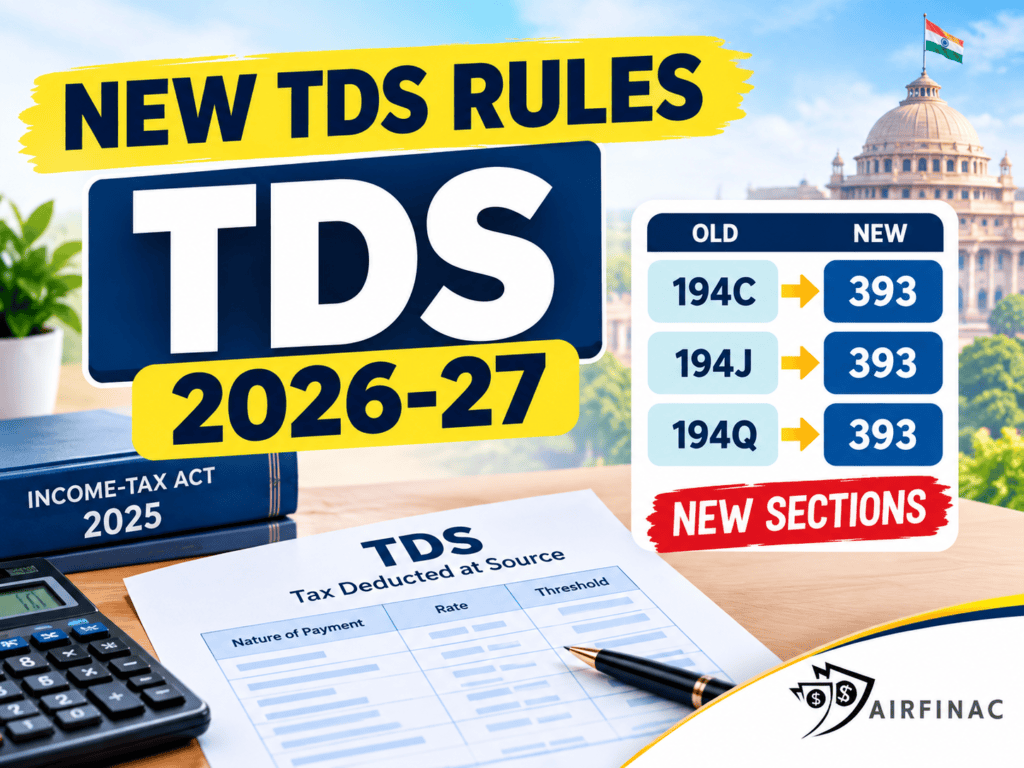
Old TDS Sections vs New TDS Sections: 2026-27 Mapping
For accounting and compliance teams referencing the TDS Rate Chart 2026-27, this mapping offers clear section alignment across frameworks:
| Old Section – Income-tax Act, 1961 | Nature of Payment | New Reference – Income-tax Act, 2025 |
| 192 | Salary | 392 |
| 192A | EPF Withdrawal | 392(7) |
| 193 | Interest on Securities | 393 |
| 194 | Dividend | 393 |
| 194A | Interest | 393 |
| 194C | Contractor Payments | 393 |
| 194D | Insurance Commission | 393 |
| 194H | Commission / Brokerage | 393 |
| 194I | Rent | 393 |
| 194J | Professional / Technical Services | 393 |
| 194K | Mutual Fund / Unit Income | 393 |
| 194N | Cash Withdrawal | 393(3) |
| 194Q | Purchase of Goods | 393 |
| 194R | Benefits / Perquisites | 393 |
| 194S | Virtual Digital Assets | 393 |
| 194T | Payments to Partners | 393(3) |
| 195 | Certain Non-Resident Payments | 393(2) |
The new Act therefore does not mean that every underlying TDS rule has been fundamentally changed. In many cases, the major difference is the statutory location and reporting reference.
Why TDS Payment Codes Matter in 2026-27
A major practical issue for accountants using the TDS Rate Chart 2026-27 is the introduction of specific payment codes associated with the new TDS framework:
- 1023 – Contractor, Individual/HUF
- 1024 – Contractor, other than Individual/HUF
- 1026 – Technical Services
- 1027 – Professional Services
- 1031 – Purchase of Goods
- 1033 – Benefits/Perquisites
- 1035 – E-commerce
- 1037 – Virtual Digital Assets
- 1067 – Payments to Partners
These codes can become important during TDS return preparation, accounting software configuration, ERP master creation, TDS reconciliation, vendor master setup, payroll configuration, correction statements, and compliance reviews.
The Income Tax Department has specifically cautioned that quoting an old section number for a transaction governed by the new Act can result in processing or validation problems.
TDS Threshold vs TDS Rate: Why Both Matter
When determining TDS, many taxpayers immediately look at the percentage. However, the first question should often be: Has the applicable threshold been crossed?
For example, if a provision has a ₹50,000 threshold, simply knowing that the rate is 10% is not enough. The compliance process should generally be:
- Identify the nature of payment
- Identify the recipient category
- Check the applicable threshold
- Determine the correct new-Act provision
- Select the correct payment code
- Apply the prescribed TDS rate
- Deposit and report the TDS correctly
This approach can significantly reduce classification and reporting errors.
TDS During the Transition from FY 2025-26 to TY 2026-27
The transition date is extremely important.
- Payments/Credits up to 31 March 2026: Transactions governed by the old framework continue under the Income-tax Act, 1961.
- Payments/Credits from 1 April 2026: Transactions falling within the new tax year are governed by the Income-tax Act, 2025.
The Income Tax Department has clarified that the triggering event and applicable transition rules determine which Act governs the TDS obligation.
Simple Timeline
- 31 March 2026 or earlier → Old Income-tax Act, 1961
- 1 April 2026 onwards → Income-tax Act, 2025 for Tax Year 2026-27
This distinction is particularly important for invoices, year-end provisions, salary payments and contracts spanning March and April.
What Happens If the Wrong TDS Section Is Used?
Suppose a business makes a contractor payment in April 2026 but reports it using the old Section 194C reference. The underlying TDS rate may still be correct, but the reporting reference can be wrong.
The Income Tax Department has stated that use of the old section number for a transaction governed by the new Act may lead to processing errors, and a correction statement may be required.
Therefore, companies should update their TDS masters, vendor masters, ERP systems, payroll software, accounting software, TDS return utilities, and internal compliance checklists before processing large volumes of Tax Year 2026-27 transactions.
TDS Forms: Old vs New Form Numbers
The transition also affects the numbering of certain TDS-related forms.
| Earlier Form | New Form |
| Form 24Q | Form 138 |
| Form 26Q | Form 140 |
| Form 27Q | Form 144 |
| Form 27EQ | Form 143 |
| Form 16 | Form 130 |
| Form 16A | Form 131 |
For example, the Income Tax Department confirms that Form 138 is the new form corresponding to Form 24Q for reporting TDS on salary, pension or specified interest income. The e-filing portal has also made the new Income-tax Act, 2025 forms available separately from forms relating to the old Act.
Important TDS Compliance Points for TY 2026-27
- Verify PAN: Where a valid PAN is not furnished, higher TDS provisions may apply subject to the applicable law. Therefore, businesses should maintain accurate PAN records for vendors, contractors, professionals and other deductees.
- Do Not Check Only Individual Invoices: Several TDS provisions operate using aggregate thresholds. For example, contractor payments and purchase-of-goods transactions can require cumulative monitoring. A proper vendor-wise TDS tracker can prevent missed deductions.
- Correctly Identify the Recipient: The applicable rate can depend on whether the recipient is an Individual, HUF, Company, Firm, LLP, Resident, Non-resident, Senior citizen, or other specified category. Therefore, recipient classification should be completed before selecting the payment code.
- Update Accounting Software: Businesses using Tally, ERP systems, payroll software or customised accounting applications should update their TDS masters for Tax Year 2026-27.
- Be Careful With Non-Resident Payments: Payments to non-residents can involve additional considerations such as applicable withholding provisions, tax treaties/DTAA, Permanent Establishment considerations, surcharge, Health and Education Cess, documentation, tax residency, and lower/nil deduction certificates. Such transactions should not be classified solely by looking at a domestic resident TDS rate.
Income Tax Slab for Senior Citizens FY 2025-26- click here
Frequently Asked Questions: TDS Rate Chart 2026-27
Q1: Have TDS tax rates changed under the Income-tax Act, 2025 for Tax Year 2026-27?
A: No. Primary TDS rates and monetary thresholds have largely been retained. The main change reflected in the TDS Rate Chart 2026-27 is structural consolidation—moving old sections into Sections 392, 393, and 394 along with new 4-digit payment reporting codes.
Q2: What is the new TDS section for salary payments from 1 April 2026?
A: Salary-related TDS is now governed by Section 392 of the Income-tax Act, 2025 (replacing old Section 192). Employers must report salary deductions using new payment codes such as 1001, 1002, or 1003 depending on employee type.
Q3: What are the new section references for contractor and professional fees?
A: Payments to contractors (formerly Section 194C) are mapped to Section 393(1), Table 6(i) under codes 1023 (Individual/HUF) and 1024 (Others). Professional services (formerly Section 194J) are mapped to Section 393(1), Table 6(iii) under code 1027.
Q4: What happens if a business files TDS returns using old 1961 Act section numbers?
A: Quoting legacy section references (such as 194C or 194J) for transactions occurring on or after 1 April 2026 triggers system-level validation errors on the e-filing portal, requiring a correction statement.
Q5: Which new forms replace Form 24Q and Form 26Q?
A: For Tax Year 2026-27 onwards, Form 138 replaces Form 24Q (salary TDS), and Form 140 replaces Form 26Q (non-salary resident TDS).
Q6: Why must businesses monitor cumulative transaction limits rather than single invoices?
A: Provisions like contractor payments (code 1023/1024) and purchase of goods (code 1031) apply aggregate annual limits (e.g., ₹1,00,000 aggregate or ₹50 lakh purchases). Tracking vendor-wise totals prevents missed deductions once thresholds are breached.
Q7: How should accounting software be configured using the TDS Rate Chart 2026-27?
A: Finance and payroll teams must update ERP masters, vendor records, and tax deduction rules to map transactions directly to Section 392/393 table references and their respective 4-digit payment codes prior to processing FY 2026-27 entries.
DISCLAIMER-Airfinac.com, its author/writer and associates do not provide tax, legal or accounting advice. This material has been prepared for informational purposes only, and is not intended to provide, and should not be relied on for, tax, legal or accounting advice. You should consult your own tax, legal and accounting advisors before engaging in any transaction.